
The country's economy will start witnessing a growth of 6.5 to 7 per cent from fiscal 2023 onwards, helped by various reforms undertaken by the government so far and also as COVID-19 vaccination drive progresses, Chief Economic Advisor Krishnamurthy Subramanian said. He said the second wave of COVID-19 is unlikely to have a very significant on the economy. The country's economy contracted by 7.3 per cent in fiscal 2020-21. "Together with the reforms and focus on vaccination, I expect growth to start hitting close 6.5 to 7 per cent from FY23 onwards and accelerate from there on," Subramanian said at a virtual event organised by Dun & Bradstreet.

The further expansion and upgrade of the Chinese military does not augur well for India, which continues to confront an increasingly belligerent China on its borders, notes former foreign secretary Shyam Saran.

Concerned over an increased level of protectionism, the World Bank found India to be the most active nation in initiating anti-dumping measures against imports affecting 19 countries.
India is much better placed today to deal with future waves of the pandemic relative to the first wave, RBI deputy governor Michael Patra said.

A weak rupee, though seemingly good for exporters, would push up input cost further for Indian companies.

Ahead of the Union Budget for 2023-24, Budget makers have welcomed the global consensus view that India will remain one of the bright spots in calendar year 2023. But there is some alarm over the grim global situation and how that might impact the Centre's projections and assessments for next financial year. The big global headwinds include a deep and sustained recession in the West, including India's biggest trading partners in North America and Europe, continuing volatility in commodity markets, and renewed Covid-19 fears, as lifting of strict curbs by China could potentially lead to a massive spread again.

It said New Delhi increased its purchase of foreign exchange over the first three quarters of 2017 which does not appear necessary.
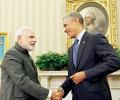
More than a dozen organisations, businesses and clean energy venture capitalists have appealed to US President Barack Obama to collaborate with Prime Minister Narendra Modi to develop a "Power India" initiative.

What the reserves offer for now is improved import coverage of about 13 months, almost double the 2013 level of less than seven months. And, ammunition to arrest a rapid rupee slide, says Anup Roy.

'Now is the time for India to course correct and for the government also to course correct,' says businessman Mangesh Khatri.

India's politicians need to do a better job of managing the economy: Inflation control, productivity improvement, etc, asserts T N Ninan.

With satisfactory progress of monsoon rainfalls prompting farmers to bring in additional area under basmati sowing, prices are set to fall lower going forward.
For the last few years, the assumption in much of the economic discourse has been that India is on an assured path of rapid growth.
India's current account deficit widened to $6.1 billion and the trade deficit increased to $18.5 billion even as exports surged by 17 per cent in the first quarter of the current fiscal.

Inflation targeting has worked well and the government must stay with it, and the framework is going to work well in the period ahead also, former RBI Governor D Subbarao said on Thursday. He also said low inflation contributes to sustainable growth. Addressing the 'Times Network India Economic Conclave' virtually, Subbarao said the government's proposal to privatise some public sector units is not akin to selling family silver but it is a route for putting India on a sustainable growth path.

Moody's expects macroeconomic policies to contribute to sustained robust growth.

FPIs, which are holding large exposures in Indian debt, could also be expected to book some capital gains as yields slide down

'What will this supposedly more business-friendly government do if it gets a second term?' 'Important labour law and land reforms remain off the table.' 'Witness the arm-twisting of foreign players in e-commerce and all but one player in telecom -- and it is very hard to justify this perception that the BJP is business friendly.' 'There will also remain the real risk of ideas seemingly gleaned from the pages of Amar Chitra Katha, overlaid with PowerPoint presentations,' predicts Rahul Jacob.

The criticism that the Reserve Bank of India was behind the curve in hiking interest rate to tame rising inflation is unfair, former RBI Governor D Subbarao said on Wednesday and asserted that it is difficult for any central bank to anticipate the future more accurately. Earlier this month, Monetary Policy Committee (MPC), the central bank's rate-setting panel, surprised the markets with a 40 basis points hike in repo rate in an off-cycle policy meeting. It was also the first rate hike after August 2018, amid spiralling inflation.

China's slowing means commodity markets are no longer overheated.

'We are allowing FDI on the terms of the investors, multinationals.' 'We bow down to whatever they say.' 'When they say you open this sector, we open that sector.'

So, while it is great that India's numbers look relatively good, don't raise a cheer just yet, points out T N Ninan.

Nomura has forecast the rupee at 61.6 against the dollar in Q1 and at 62 by Q4 of 2015.

India remains North Korea's 2nd-largest import source after China, according to several estimates by multilateral bodies, says Subhayan Chakraborty.

Secretary of State Mike Pompeo said that countries like India, if it gets the exemption, would be asked to bring down their oil imports from Iran to zero in six months' time.

'Initially, Gift City was just another real estate project, but all that changed with Modi moving to New Delhi,' notes Tamal Bandyopadhyay.

Gold demand in India is expected to be robust in 2014, likely leading to a further jump in smuggling if curbs on bullion imports remain, the World Gold Council (WGC) said.
The broader markets gained with mid-caps and small-caps rising 0.7-0.9 per cent on the BSE.

India will welcome two trade missions in 2015 focused on meeting its infrastructure needs with US technology and services.

India's GDP may turn positive at 1.3 per cent in the third quarter of 2020-21, having witnessed contraction in the previous two quarters due to the coronavirus pandemic, as the number of cases is falling and public spending has started rising, according to a report. The government will release the GDP numbers for the October-December quarter of the current fiscal on Friday. Projecting that the gross domestic product (GDP) may have returned to the black in the last quarter of the calendar year 2020, DBS Bank in the report said the full-year growth in real terms may be at a negative 6.8 per cent.

The currency market won't care for our moans, groans, cries and sighs. The rupee will find its own level, explains Tamal Bandyopadhyay.
"We see the Indian economy rebounding from our projected 6.1 per cent growth this fiscal year to something like 7 per cent in the next fiscal year (2020). We see the factors that will support growth, including monetary policy stimulus, working their way through the pipeline," Jonathan Ostry, Deputy Director, Asia Pacific Department at the IMF, told reporters.

With Iran reaching an agreement on its nuclear programme, India is expected to be one of the major gainers.

'Indian and Iranian sources both confirmed to me that India and Iran are moving ahead to implement a payment system on buying oil from Iran and hope to finalise it very soon,' says Aveek Sen.

'It is far too early to celebrate the numbers.' 'They are still fairly weak compared to the pre-pandemic level.'

Yuan depreciation will make imports in China more expensive, depressing demand, especially for commodities.

'There will always be a challenge to maintain a fine balance to ensure that the growth keeps happening and inflation is contained.'

The simultaneous decline of several trade-related indicators should put policy makers on guard for a sharper slowdown.

The country imported 9.31 million tonnes (mt) of steel in FY15.
India imports more than it exports, so the rupee's decline will hurt more than it may help.
